Enterprise AI Architecture & Delivery Leadership

AI Grounded in Enterprise Knowledge

I help knowledge-heavy organizations build enterprise AI that works in production.

For pharma, life sciences, manufacturing, insurance, and other high-stakes industries where AI must be accurate and trustworthy.

Discuss Your AI Initiative Explore How I Help

30-minute confidential intro. No generic sales pitch.

20+ Years in Enterprise Software, AI & Data 4M+ Enterprise Documents Unified in Global Pharma Former CTO — PoolParty (now Graphwise)
Enterprise AI Architecture — semantic retrieval, knowledge graphs, and grounded AI

Sound Familiar?

Enterprise AI struggles when knowledge is fragmented, disconnected, and impossible to trust.

Fragmented Knowledge

Critical enterprise knowledge is spread across disconnected systems, leaving AI without reliable context.

Hallucinations in High-Stakes Environments

Plausible but incorrect answers are unacceptable when decisions affect quality, compliance, operations, or patient outcomes.

Missing Explainability

AI delivers answers but can't explain where they came from — making it impossible to verify, audit, or trust in regulated environments.

PoCs That Can't Scale

The demo worked. Scaling across enterprise systems, governance, and evaluation is where momentum stalls.

Slow AI Adoption

Every new AI initiative rebuilds access to enterprise knowledge from scratch — making delivery slow and expensive.

No Way to Measure Quality

Without evaluation and governance, teams debate outputs instead of improving them systematically.

How I Help

Three focused engagements designed for enterprise AI leaders who need clarity, architecture, and results — not more slide decks.

01

AI Assessment & Rescue

Diagnose why your enterprise AI underperforms. Get a pragmatic path forward.

Your AI system is live but the results are disappointing — inconsistent answers, weak retrieval, low adoption. Before rebuilding anything, you need a clear diagnosis.

What's included:

  • Architecture review & failure mode analysis
  • Retrieval quality assessment
  • Semantic layer & knowledge structure review
  • Evaluation framework assessment
  • Prioritized improvement roadmap

Outcome: A clear, actionable diagnosis with a prioritized roadmap — so you fix root causes, not symptoms.

Assess Your Situation
03

AI Delivery Leadership

Move enterprise GenAI from prototype to reliable production.

You have a working prototype but no clear path to production. I provide hands-on technical leadership to bridge the gap — architecture decisions, team guidance, and evaluation governance.

What's included:

  • Architecture leadership & roadmap ownership
  • Technical decision support (vendor, tools, stack)
  • Team mentoring & implementation oversight
  • Evaluation governance & quality frameworks
  • Stakeholder communication & alignment

Outcome: Your GenAI initiative moves from "promising demo" to production system — with clear ownership, quality gates, and measurable progress.

Discuss Delivery Needs

Case Study: From Fragmented Knowledge to Enterprise AI at Pharma Scale

The Challenge

A global pharmaceutical organization needed to make critical enterprise knowledge reliably accessible through AI.

Relevant information was distributed across 4+ million documents spanning five disconnected enterprise systems, with inconsistent metadata, terminology, and document structures.

Early AI approaches exposed limitations in retrieval relevance, grounding, and answer consistency — particularly in a regulated environment where reliability and traceability matter.

The Solution

Designed an enterprise semantic AI architecture combining:

  • Hybrid retrieval
  • Semantic modeling
  • Ontology-driven knowledge organization
  • Entity and relationship enrichment
  • Evaluation-driven quality improvement
  • Query understanding & retrieval optimization

The architecture was designed around real business questions and knowledge workflows — not around technology for its own sake.

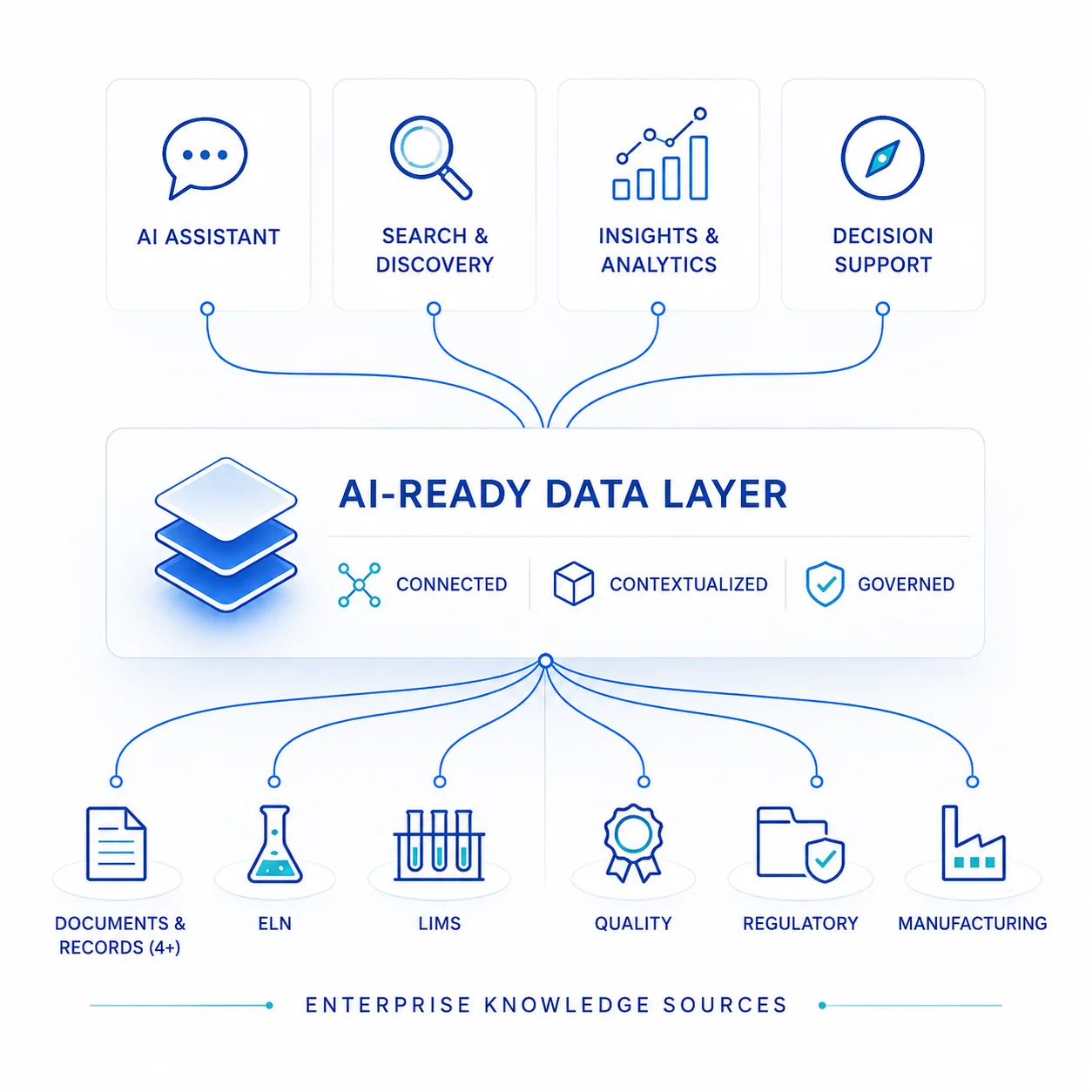
Enterprise Semantic AI Architecture — from enterprise knowledge sources through semantic AI foundation to grounded answers and trusted decisions

My Role

I led the technical teams responsible for making enterprise knowledge findable, retrievable, and usable by AI — spanning knowledge indexing, intelligent retrieval, and conversational AI.

Across these teams, I contributed to:

  • Leading the semantic retrieval, knowledge indexing, and conversational AI workstreams
  • Semantic architecture design & knowledge modeling
  • Knowledge indexing & ingestion pipeline strategy
  • Retrieval strategy definition & optimization
  • Question-answering architecture
  • Evaluation framework design & quality governance
  • Stakeholder alignment across technical and domain teams

Today, the platform serves thousands of users across the organization — providing AI-powered chat and search over a unified knowledge layer. It has become the backbone for further AI initiatives built on top of the same semantic foundation.

Impact

4M+ Enterprise documents made AI-accessible
5 Systems Enterprise pharma systems unified into one semantic AI architecture
1,500+ Users served — backbone for further AI initiatives
€3M+ Estimated annual business impact from AI-driven knowledge access

Why Enterprise Teams Work With Me

Tomas Knap — Enterprise AI Consultant

I've spent 20+ years building software, data, and AI systems for complex enterprise environments — and the last decade focused on making enterprise AI work reliably at scale.

I'm Tomas Knap. As former CTO at Semantic Web Company / PoolParty (now Graphwise), I led architecture, product strategy, and engineering teams delivering enterprise AI platforms that combine LLMs, semantic technologies, and knowledge graphs for organizations in pharma, manufacturing, and the public sector.

That work included designing and leading systems that unified millions of enterprise documents from disconnected sources into semantic AI infrastructure — powering AI-driven search, chat, and knowledge discovery for thousands of enterprise users in regulated environments.

Today, I work with enterprise AI leaders who need hands-on architecture and delivery leadership — someone who has built production AI systems in environments where fragmented knowledge, compliance requirements, and stakeholder complexity are the norm, not the exception.

Background 20+ years in enterprise software, data & AI · Former CTO at Semantic Web Company / PoolParty (now Graphwise)
Proof AI platforms serving 1,500+ enterprise users · 4M+ documents unified across global pharma knowledge systems
Specialization Semantic architecture · Retrieval engineering · AI evaluation · Delivery leadership
Industries Pharma · Life sciences · Manufacturing · Insurance · Knowledge-intensive enterprises

Let's Discuss Your AI Initiative

Whether you're designing a new enterprise AI initiative, scaling a prototype to production, or improving an existing system — let's talk. A focused conversation about your situation — not a generic sales call.

What to expect: A 30-minute focused conversation about your enterprise AI initiative. No sales pressure. If I can help, I'll tell you how. If I can't, I'll tell you that too.

Your message goes directly to me. I personally review every inquiry.

Prefer email? [email protected]

Frequently Asked Questions

When does semantic architecture make sense?

When your AI needs to work with large, complex, or multi-source knowledge — not just a handful of documents. If your organization has millions of documents across disconnected systems, inconsistent terminology, or domain-specific language, a semantic layer is what makes retrieval reliable. Without it, you're searching keywords, not meaning.

Do I need a knowledge graph?

Not always. Knowledge graphs are powerful when your domain has rich relationships between entities — products, regulations, processes, people. But they're not a default requirement. I assess whether a knowledge graph adds value for your specific use case, or whether a well-designed semantic layer with hybrid retrieval is sufficient.

Can you help rescue an existing RAG system?

Yes — this is one of the most common engagements. Many organizations have a RAG prototype that works in demos but fails in production: wrong documents retrieved, hallucinated answers, inconsistent quality. I diagnose the root causes — how documents are processed, how retrieval is structured, and whether there's a proper evaluation framework — and provide a concrete improvement roadmap.

Do you work with internal teams?

Absolutely. I don't replace your team — I accelerate them. I work alongside your engineers, data scientists, and architects to make better decisions faster. Think of it as embedded technical leadership: I bring the enterprise AI architecture experience, your team brings the domain knowledge and continuity.

What industries do you work with?

I focus on knowledge-heavy industries where AI accuracy and grounding matter most: pharma, life sciences, manufacturing, insurance, and enterprise organizations with large document collections. The common thread is complex, regulated, or high-stakes knowledge that AI must handle reliably.

How do engagements typically start?

With a 30-minute conversation about your situation — no pitch, no pressure. If there's a fit, we scope a focused engagement (usually an assessment or architecture sprint) with clear deliverables and a defined timeline. Most clients start with a 2–4 week assessment before committing to longer engagements.